

Google's Project Aristotle found psychological safety to be the most important factor in team effectiveness. Teams where people feel safe to take risks and admit mistakes make better use of each other's ideas, which is exactly what innovation needs. People need to be able to propose ideas, challenge the status quo and admit when something failed without being punished. Without it, no architecture will help.
But it’s also about system architecture that can enable innovation or make it more challenging.
Most good ideas aren't rejected. They just never get tried, because trying is too slow. The lead time from idea to production tested idea might be long due to:
- Data is not available
- It’s difficult to get access to right data or API owned by another team
- Data is not ready to be used
- Data freshness and quality issues
- Data interpretation issues
- Additional use of the data might cause performance or other implications to source systems
- Setting up new environments is not automated
- Manual approval processes
- Approval for funding and costs
- Difficult to find decision makers
System architecture and a robust IT landscape can mitigate at least some of these concerns or blockers.
How can architecture support innovation?
Architecture is a wide area. It ranges from tech direction defined by enterprise architecture to how a single application is structured, and from how teams are organized to how information is defined. All of these affect an organization’s capability to innovate.
This post takes one specific view: productized platforms and golden paths. There are many other ways architecture supports innovation, such as modular, loosely coupled software that is easy to change, or team boundaries that match the business. I focus on platforms because they are the most concrete lever: they lower the cost of every experiment, not just one.
When thinking about innovation, I think it's good to ask yourself and your organization three questions:
- How cheap it is to try: time, money and effort per experiment
- How safe it is to try: what happens if the experiment goes wrong
- How do we make it easier to say yes to innovation initiatives?
Platforms answer all three with paved roads. Instead of every team building its own foundation and asking for permission, the platform offers a ready path where security and quality are built in. Guardrails replace approvals, so teams can experiment freely within known boundaries.
AI agents are changing what "cheap to try" means. When an agent can write a working prototype in an afternoon, writing code is no longer the expensive part. What remains expensive is everything around the code: getting to the data, understanding what it means, finding an environment to run in, and getting permission to try. That's where architecture comes in.
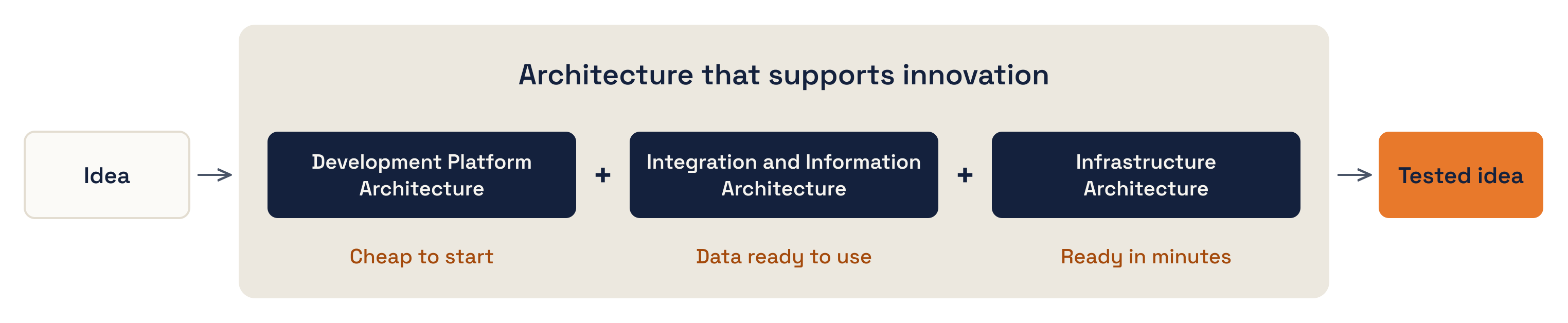
Every idea needs the same three things before it can be tested: a place to build it, data to work with, and an environment to run it in. Each of these is an architecture area of its own: development platform architecture, integration and information architecture, and infrastructure architecture. When all three are in good shape, an idea can move from "this could work" to a real experiment without weeks of waiting.
1. Development Platform Architecture
Development Platform Architecture and golden paths enable ready development capabilities and building blocks
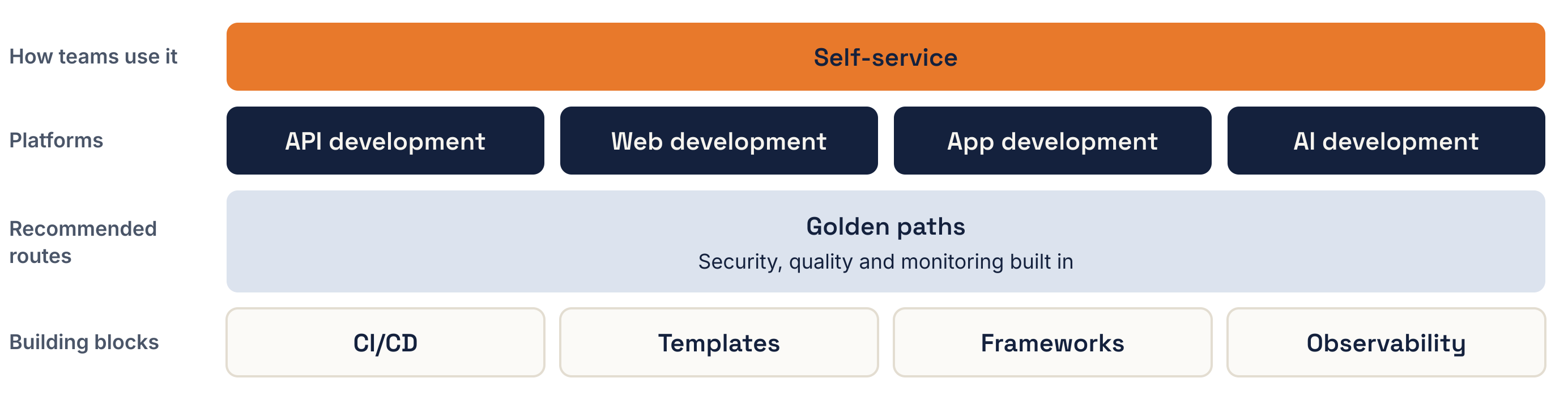
Standardized and productized development platforms are one of the most concrete ways architecture makes it cheap to try. Shared building blocks, templates and golden paths offered as self-service make it easy to set up new solutions.
A team or AI agent picks the right platform, follows the golden path and spends its time on what's actually new, not on rebuilding pipelines, logging or security. Because the golden path is the easiest way and also the safe way, experiments meet our standards by default, and saying yes to trying something becomes easy.
The same applies to AI agents. When an agent builds a prototype, golden paths, templates and platform documentation are its instructions. They are how it learns to build the right way, so its output meets the same standards as everyone else's.
2. Integration and Information Architecture
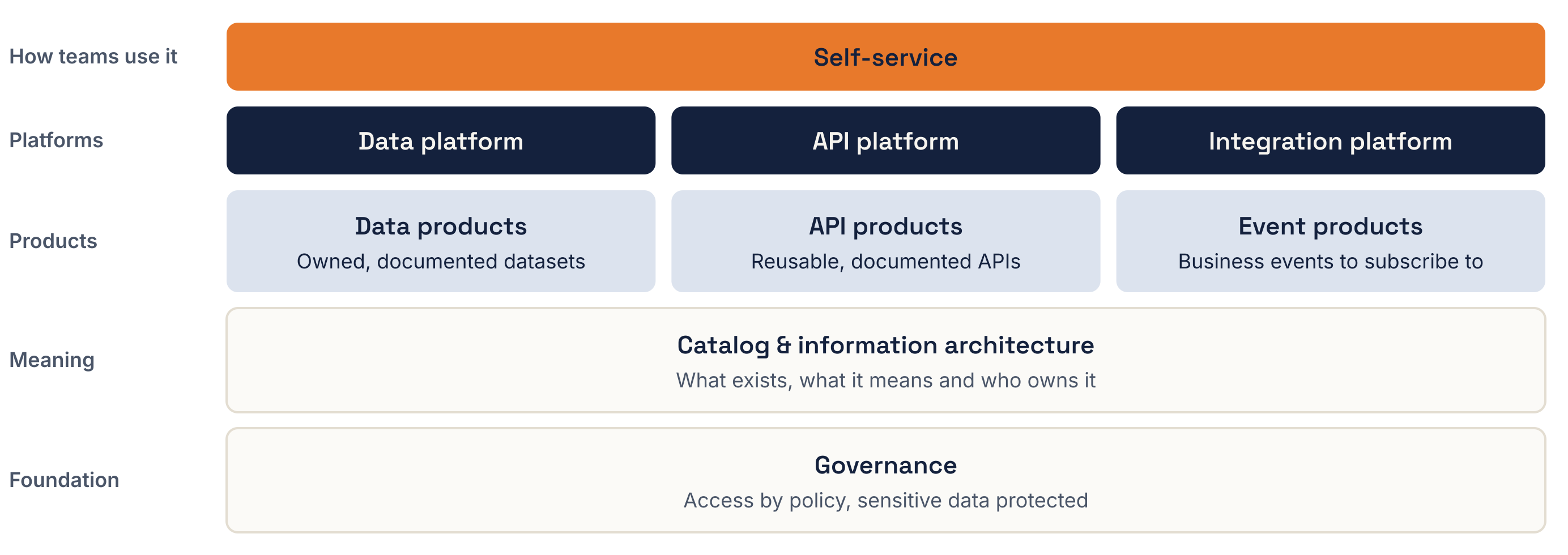
Integration and information architecture enable easy access to the documented and curated data
Data is typically an important ingredient for innovation. Data runs through every stage of innovation: finding the idea, testing it, building it, and deciding whether to keep it. Data turns innovation from guessing into learning. It shows where the problems are, tells you whether your idea actually helped.
Data is typically scattered across multiple source systems. From an integration architecture perspective, a key question is: How should we extract data from the source systems? Without proper integration architecture and data platforms, every new idea starts by paying a “data tax”.
Integration architecture determines how to make data available safely and sustainably without overloading the source systems. Data can be made available via e.g. change data capture, events and APIs. For AI agents, MCP (Model Context Protocol) servers add a standard way to reach the same platforms and data products.
Standardized and documented data or API products can significantly speed up the innovation process and especially if self-service capabilities enable easy access to data.
Information architecture
In enterprise architecture, information architecture means how an organization defines, structures and governs its information. What the key concepts are, what they mean, how they relate, and who owns them.
How does information architecture help innovation? For innovation, it does three things: it lets teams trust and combine data without reverse-engineering it, it makes it safe to grant access, and it gives AI agents the context they need to be useful. If the integration architecture and data platform make data available, information architecture makes it understandable.
3. Infrastructure Architecture
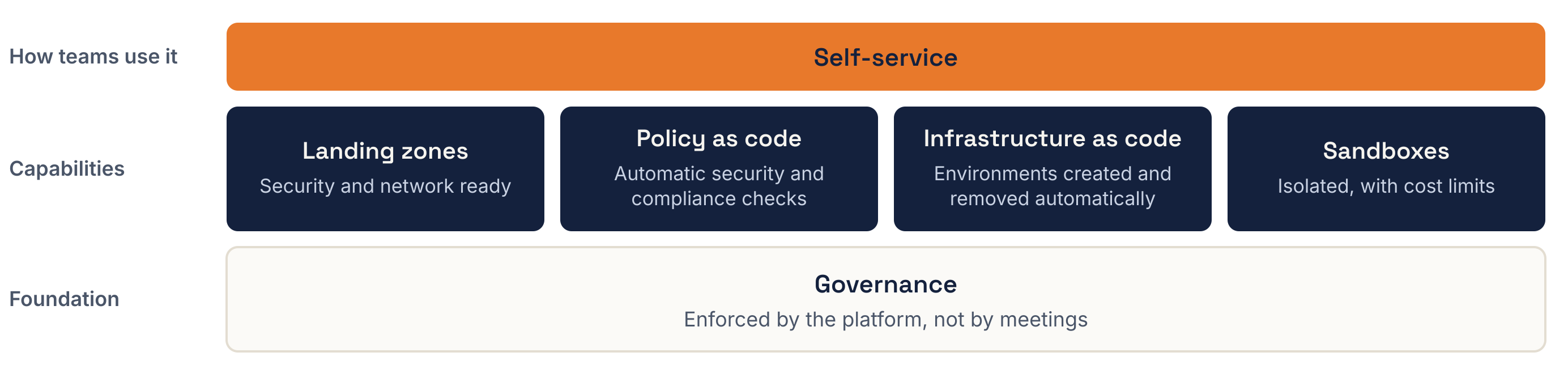
Good infrastructure architecture makes environments ready in minutes, with the rules already built in, so experiments are cheap to start and easy to throw away.
Infrastructure is where the cost and risk of trying something new are often decided, long before anyone writes a line of code. If getting an environment takes weeks of tickets and reviews, only ideas that are already certain get tried.
Infrastructure and cloud architecture is designed to remove that wait. Through self-service, sandbox is available in the same day. It is created automatically inside the landing zone, so networking and security are already in place, and every change is checked against policies as it happens. No review meeting, no ticket queue. If the idea doesn't work, the environment is removed just as easily, and the cost limits mean it never turns into a surprise bill. If it does work, it already meets the rules production requires.
The same guardrails let AI agents experiment safely. An agent working in a sandbox, within rules checked by policy as code, doesn't need a human to approve each step.
All of this sits on governance that is enforced by the platform rather than by meetings, and teams use it through self-service. The point isn't less control. It's control that is built in, so that saying yes to an experiment is the safe default instead of a risk someone has to sign off.
Conclusion
Innovation is less about having great ideas and more about how many ideas you can afford to test. Architecture has a direct effect on that. Development platforms and golden paths make it fast to start. Integration and information architecture make data available and understandable. Infrastructure architecture makes environments ready in minutes, with security and compliance already built in. Together they answer the three questions from the start: trying becomes cheap, failing becomes safe, and saying yes becomes the default.
AI agents make this even more important. As writing code gets cheaper, the cost of trying moves to everything around the code, which is exactly where architecture works. And when trying becomes nearly free, the number of experiments grows quickly. Architecture also has to keep that volume manageable: easy to review, cheap to run and clean to shut down.
Architecture can't solve everything. Funding, approvals and finding the right decision makers are organizational questions, and without psychological safety, even the best platform goes unused. But architecture can remove much of the friction that keeps good ideas from ever being tried.
It also changes the architect's role. Instead of reviewing and approving each initiative, the architect's job is to build the guardrails and paved roads so that most ideas never need an approval at all. Guardrails replace "ask for permission first" with "anything inside these boundaries is already allowed". That's what making it cheap to try really means.